
A 5-channel amplifier promises to run your whole system — four speakers plus a subwoofer — from one box instead of two. That’s a genuine, practical upgrade for the right build, but there’s a real technical detail most buyers don’t know until after they’ve installed one: the 5th channel usually isn’t built like the other four. This guide compares five real 5-channel amps and explains exactly what that means for your system before you buy.
Picks at a Glance
| Amp | Total RMS | |
|---|---|---|
| Top Pick: AudioControl EPICFIVE | 1100W | Check Price |
| Strongest Sub Channel: Recoil RED1800.5 | 1800W | Check Price |
| Best Budget: Planet Audio AC1800.5 | ~900W | Check Price |
The Top Pick
AudioControl EPICFIVE
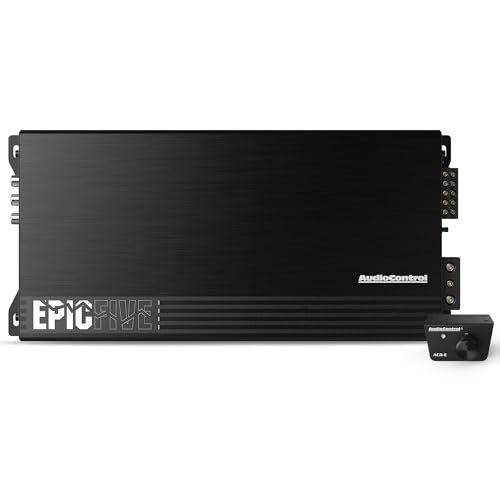
- 75W x4 + 300W x1 @4Ω / 150W x4 + 500W x1 @2Ω / 700W @1Ω (CH5) — 1100W total RMS
- Real dimensions: 6.1″ W x 13.35″ L x 2.01″ H
- Class D, 1-ohm stable, Linkwitz-Riley 12dB/octave filters (HP/LP/subsonic)
- Includes wired ACR-E remote bass control and Epicenter Link harness
The highest-rated amp in this roundup, and it earns that with real engineering, not just a good price. The Epicenter Link is a genuine differentiator: a dedicated 1-meter harness built specifically to connect this amp directly to AudioControl’s own Epicenter bass restoration processor (sold separately) — a real, purpose-built ecosystem rather than a generic accessory port. The Linkwitz-Riley filter topology on the crossovers is also a genuinely more precise slope design than the generic 12dB filters most budget amps use.
Worth knowing before you buy: this amp has preamp (RCA) inputs only — no speaker-level/high-level input option. If you’re running a factory head unit without RCA outputs, you’ll need a separate line-output converter or the Epicenter itself to integrate cleanly. Every other amp in this roundup includes speaker-level inputs as standard; this is the one exception.
- Highest rating in this roundup, backed by real engineering (Linkwitz-Riley filters, Epicenter Link)
- Genuinely compact chassis at just 2.01″ height
- 1-ohm stable sub channel with 700W of real headroom
- Preamp inputs only — no speaker-level input, unlike every other amp here
- Requires a line-output converter or Epicenter for factory-deck integration
The Rest of the Field
Recoil RED1800.5 — Strongest Sub Channel

- 140W x4 + 600W x1 @4Ω / 220W x4 + 980W x1 @2Ω / 1280W @1Ω (CH5) — 1800W total RMS
- Real dimensions: 14.6″ x 7.6″ x 2.2″
- Oversized 1/0 gauge power and ground terminals
- Class D, 4-way protection circuitry
The sub channel here genuinely outperforms every other amp in this roundup — 1280W RMS at 1 ohm is real, published, continuous power, not a peak number. The oversized 1/0 gauge terminals are a real, uncommon detail at this price point; most amps in this class use 4-gauge terminals, and the larger connection point reduces resistance under sustained heavy load. If your build centers on serious subwoofer output alongside a 4-speaker front/rear setup, this is the amp built for that specific priority.
- Strongest verified sub-channel output in this entire roundup
- Oversized 1/0 gauge terminals — genuinely uncommon at this price
- Both speaker-level and RCA inputs
- Larger footprint than the EPICFIVE or Stinger — worth checking your mounting space
Stinger MT-1000.5
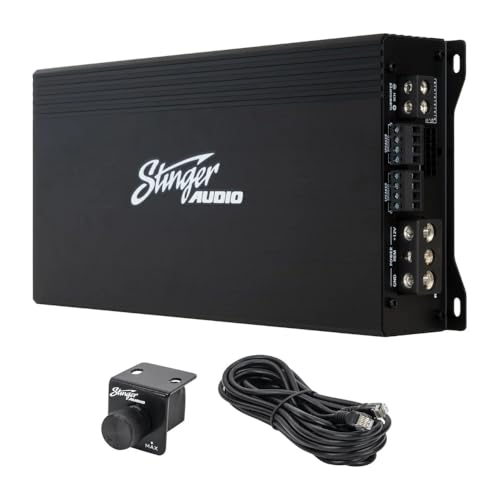
- 75W x4 + 300W x1 @4Ω / 150W x4 + 500W x1 @2Ω / 700W @1Ω (CH5)
- Real dimensions: 13.23″ L x 6.10″ W x 2.09″ H
- HEXFET MOSFET power supply, 80% average efficiency
- 150A recommended external fusing
Nearly identical channel-5 output to our Top Pick, at a lower price. Stinger’s own published spec sheet is consistent across their official site, installation manual, and every independent retailer we checked — a genuine sign of an honestly marketed product rather than inflated numbers. If you want EPICFIVE-level sub power but need speaker-level inputs for a factory-deck install, this is the more flexible option. If you’re already invested in Stinger for this amp, our wiring kits roundup covers a matching Stinger wiring option from the same brand.
- Matches our Top Pick’s sub-channel output at a lower price
- Both RCA and speaker-level inputs included
- Spec sheet verified consistent across official and independent sources
- No proprietary bass-processor ecosystem like the EPICFIVE’s Epicenter Link
NVX VAD11005 v2

- 80W x4 + 350W x1 @4Ω / 125W x4 + 600W x1 @2Ω — 1100W total RMS
- Marine-certified, conformal-coated circuit board
- Platinum-plated RCA inputs and screw terminals
- Compact at approximately 13″ long
The genuine differentiator here is corrosion resistance, and it’s worth understanding why platinum specifically: unlike gold or copper, platinum doesn’t oxidize, which matters directly in salt-air or marine environments where standard terminals corrode over time. Combined with the conformal-coated board, this is the amp built for anything beyond a standard dry car cabin — trucks, boats, UTVs, motorcycles — without sacrificing the compact footprint the rest of this roundup is built around.
- Genuine marine-grade certification and platinum-plated terminals
- Compact chassis despite the durability features
- Rated for car, truck, marine, UTV, and motorcycle use
- Lowest sub-channel output of the Class D amps in this roundup
Planet Audio AC1800.5 — Best Budget
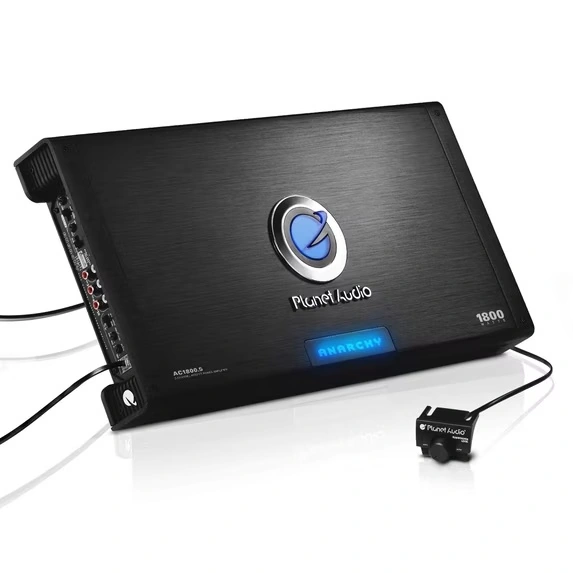
- 113W x4 @4Ω / 225W x4 @2Ω, plus 225-450W on CH5 depending on load
- Class A/B — not Class D like the rest of this roundup
- Both high and low-level inputs
- By far the most reviewed amp in the entire candidate pool (717 ratings)
Worth being upfront: this is a Class A/B amp in a roundup where everything else is Class D, meaning it runs less efficiently and generates more heat for the same output — give it real ventilation. It’s also the amp with the largest, most consistent real-world track record here by a wide margin. For a straightforward budget build where you’re not chasing 1-ohm sub headroom, that combination of proven reliability and low price is hard to argue with.
- Largest review base of any candidate we researched for this roundup
- Lowest price in this lineup
- Both high and low-level inputs for flexible source integration
- Class A/B design runs warmer than the Class D amps in this roundup — needs real airflow
- Weakest sub-channel output of the group
Why the 5th Channel Isn’t Just Another Channel
Most 5-channel amps aren’t five identical amplifier sections. Channels 1 through 4 are matched, full-range channels built to drive speakers. Channel 5 is typically designed like a monoblock bolted onto the same chassis — built specifically for subwoofer duty, with a fixed low-pass filter and no full-range option.
The real specs in this roundup prove it directly. Look at Stinger’s channels: 1-4 deliver 75-150W depending on impedance, full-range capable — but channel 5 jumps to 300-700W with a completely different impedance stability rating (1Ω vs the standard 2-4Ω of channels 1-4). That’s not “one more channel like the others.” It’s a different amplifier section entirely, sharing a chassis with four smaller ones.
This matters directly if you’re planning your build: don’t expect to run a 5th full-range speaker off channel 5 on most of these amps — it’s filtered specifically for bass. If your build genuinely needs 5 full-range channels rather than 4 speakers plus a sub, a 5-channel amp usually isn’t the right tool at all. For builds where separate amps make more sense than one 5-channel unit, our best 4-channel amplifiers and best monoblock amplifiers guides cover that path.
Setting Up Channel 5 the Right Way
Because channel 5 is built like a monoblock rather than a copy of channels 1-4, tuning it needs its own pass — not just the same gain and crossover settings you’d use on a speaker channel. Set the low-pass filter first, based on where your front speakers naturally roll off (usually somewhere between 60-120Hz for most component or coaxial setups), so the sub picks up cleanly where the speakers leave off rather than overlapping and muddying the midbass.
Gain on channel 5 should be set independently from channels 1-4, using the sub itself as the reference rather than matching whatever level you used for the speakers — the impedance and power curve are different enough that “matching” the gain knobs visually doesn’t mean matching output. If you’re setting up the full system for the first time, our car amplifier installation guide covers wire gauge, fuse sizing, and grounding fundamentals that apply to any of these amps regardless of channel count.
Full Comparison Table
| Amp | CH5 @ Lowest Ω | Class | Inputs | |
|---|---|---|---|---|
| AudioControl EPICFIVE | 700W @1Ω | D | RCA only | Check Price |
| Recoil RED1800.5 | 1280W @1Ω | D | RCA + speaker-level | Check Price |
| Stinger MT-1000.5 | 700W @1Ω | D | RCA + speaker-level | Check Price |
| NVX VAD11005 v2 | 600W @2Ω | D | RCA + speaker-level | Check Price |
| Planet Audio AC1800.5 | 450W @2Ω | A/B | RCA + speaker-level | Check Price |
Final Verdict
For most builds, the AudioControl EPICFIVE is the pick worth defaulting to — genuine engineering behind its filters and bass-processor ecosystem, at the highest rating in this roundup. If your priority is maximum sub output specifically, the Recoil RED1800.5‘s 1280W channel-5 figure beats everything else here. And if you want a proven, low-cost entry point without chasing 1-ohm sub headroom, the Planet Audio AC1800.5‘s combination of price and the largest real-world review base makes it hard to beat.
Leave a Reply
You must be logged in to post a comment.