
The Fosi Audio Box X2 markets itself as a tube phono preamp, and it genuinely does include two vacuum tubes you can see glowing through the top of the chassis. What it doesn’t make obvious in the marketing is where those tubes actually sit in the circuit — and that distinction matters if you’re buying this specifically for “tube sound.” This Fosi Audio Box X2 review covers what the tubes actually do here, the real gain-staging specs, and an honest look at whether the tonal difference is audible or mostly branding.
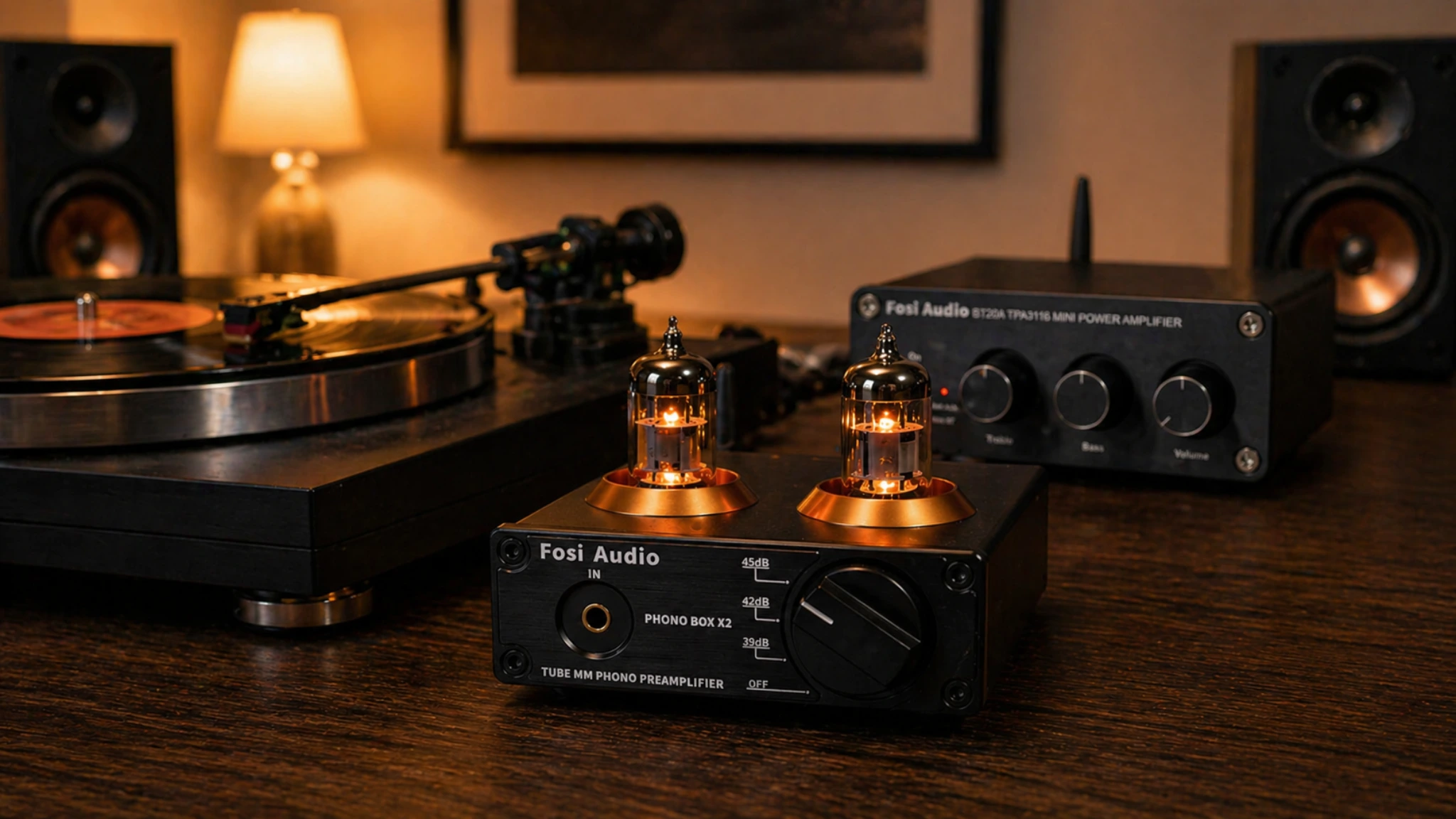
Fosi Audio Box X2 Specs at a Glance
| Spec | Detail |
|---|---|
| Design | Hybrid — solid-state gain/RIAA stage, tube output buffer |
| Gain Modes | Switchable 39dB, 42dB, or 45dB |
| Tubes | 2x 6A2 included, swappable for 6K4, 6J1, 6J4, GE5654, 6AK5, 66 |
| Inputs | RCA (MM phono) + 3.5mm AUX |
| Output | RCA line-level |
| Power | DC 12V, external adapter included |
Is This Really a Tube Preamp?
Here’s the honest engineering answer, confirmed by independent teardowns and reviews rather than just Fosi’s own marketing copy: the RIAA equalization and gain amplification in the Box X2 are handled by low-noise solid-state integrated circuits, not the vacuum tubes. The tubes sit at the output stage as a buffer, there to impart a bit of tube character on the signal after the actual amplification work is already done. That’s different from a true tube preamp, where the tubes themselves are doing the gain and equalization.
This isn’t unique to Fosi — it’s how most affordable “tube” phono preamps work, since a genuine tube gain stage costs considerably more to implement well. Where it’s worth being skeptical is the audible difference this actually makes. At least one independent reviewer who directly compared the Box X2 against a standard solid-state preamp reported hearing no noticeable “warmth” or tonal difference at all — the sound was clean and accurate, but not meaningfully different in character. If you’re buying this specifically chasing a tube sonic signature, it’s worth knowing that claim isn’t universally confirmed by people who’ve actually done the comparison.
None of this makes the Box X2 a bad preamp — the RIAA equalization and low-noise circuitry are genuinely solid for the price. It just means the “tube preamp” framing is doing more marketing work than engineering work, and buying this expecting the same sonic signature as a $500 true tube preamp would be setting the wrong expectation.
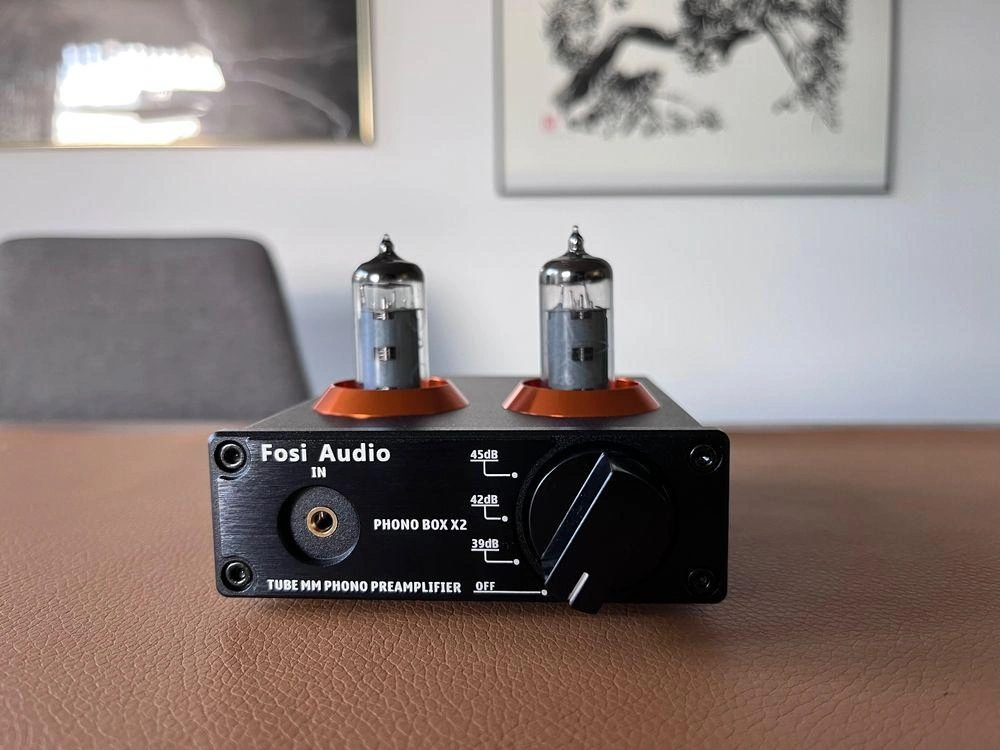
Switchable Gain — 39dB, 42dB, 45dB
The front-panel gain selector gives you three real steps — 39dB, 42dB, or 45dB — plus an off position, letting you match the preamp’s output level to your specific cartridge and amplifier combination rather than being stuck with one fixed gain setting. Higher-output cartridges typically pair better with the lower gain settings to avoid pushing your amplifier’s input into distortion, while lower-output cartridges benefit from the higher gain steps to get a usable signal level. If you’re not sure how gain staging actually affects your sound, our what does a preamp do guide covers the mechanics in more depth.
Setup and a Real Quirk to Know About
Connect your turntable’s RCA output to the Box X2’s phono input, then run the Box X2’s output to a line-level input on your amplifier or powered speakers. If your turntable already has its own built-in preamp, switch the turntable to its “line out” mode and connect it to the Box X2’s 3.5mm AUX input instead of the RCA phono input — running an already-preamplified signal into the phono input applies RIAA equalization twice, which will noticeably distort the sound.
One quirk worth knowing before you’re confused by it: with nothing connected to the RCA input, the Box X2 defaults to MM phono mode, which runs at much higher gain than the AUX input. That means an idle, unconnected unit can produce an audible hum — this is normal behavior, not a defect, and it goes away once a real source is actually connected.
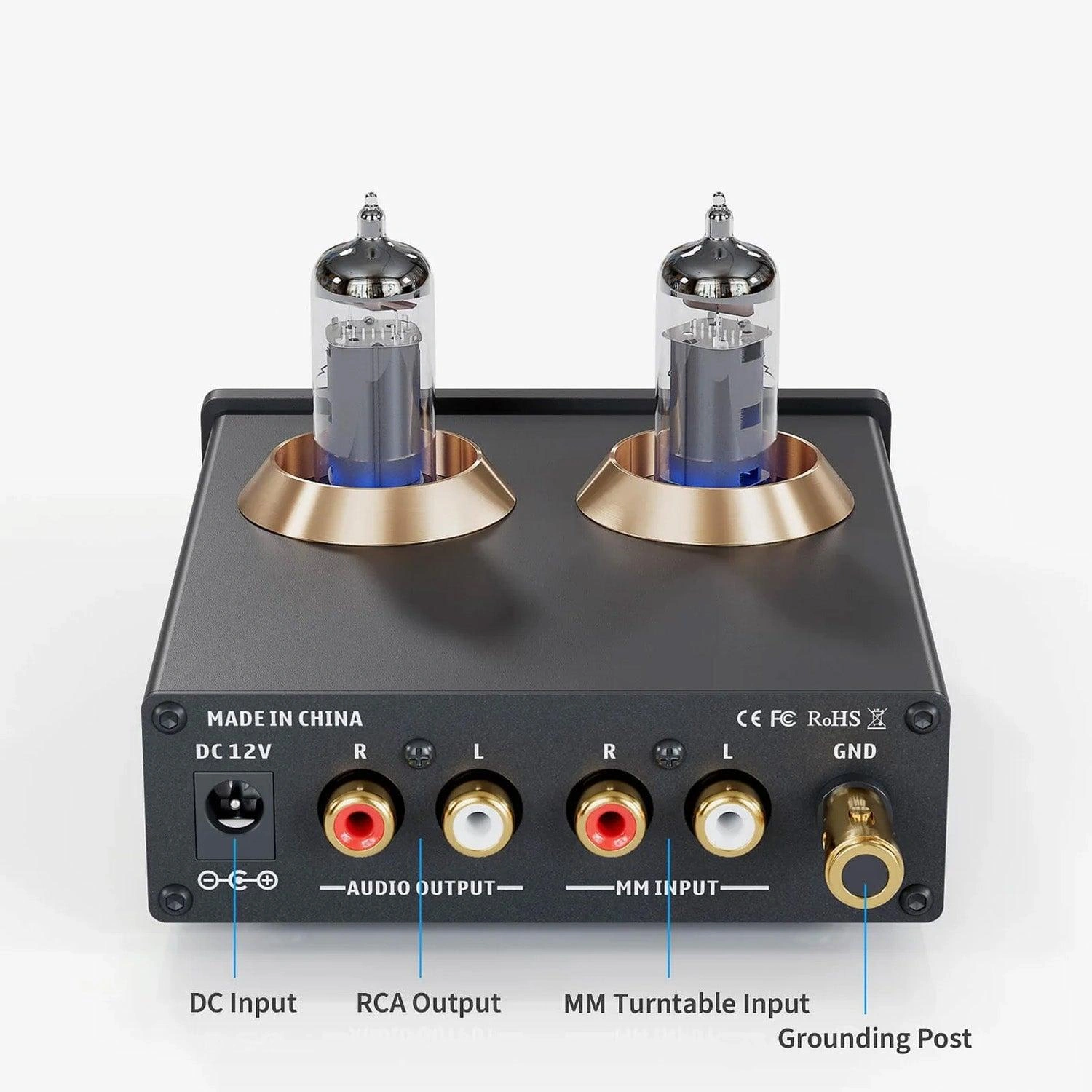
Pros & Cons
- Genuinely solid low-noise RIAA equalization and gain circuitry for the price
- Three real switchable gain steps for matching different cartridges
- Swappable tubes let you experiment, even if the sonic impact is subtle
- Grounding post included for hum reduction
- Tubes aren’t in the actual gain/RIAA path — the “tube sound” is a subtle coloration effect, not a defining characteristic
- Idle unit can hum when nothing is connected — normal, but can seem like a defect at first
- 3.5mm AUX input is a compromise connection most users won’t need
Final Verdict
Judged as a phono preamp, the Fosi Audio Box X2 does its actual job well — clean, low-noise RIAA equalization with genuinely useful switchable gain. Judged specifically as a “tube preamp,” the honest answer is that the tube marketing oversells what’s really a solid-state design with a tube-flavored output stage. Buy this for the gain flexibility and solid core engineering, not because you’re expecting a dramatically different sonic character from the glowing tubes on top.
If you’d rather skip the tube framing entirely and just want a straightforward solid-state budget preamp with a genuinely uncommon feature — cartridge-matching capacitance control — our ART DJPREII review covers a comparable-priced alternative worth weighing against this one.

